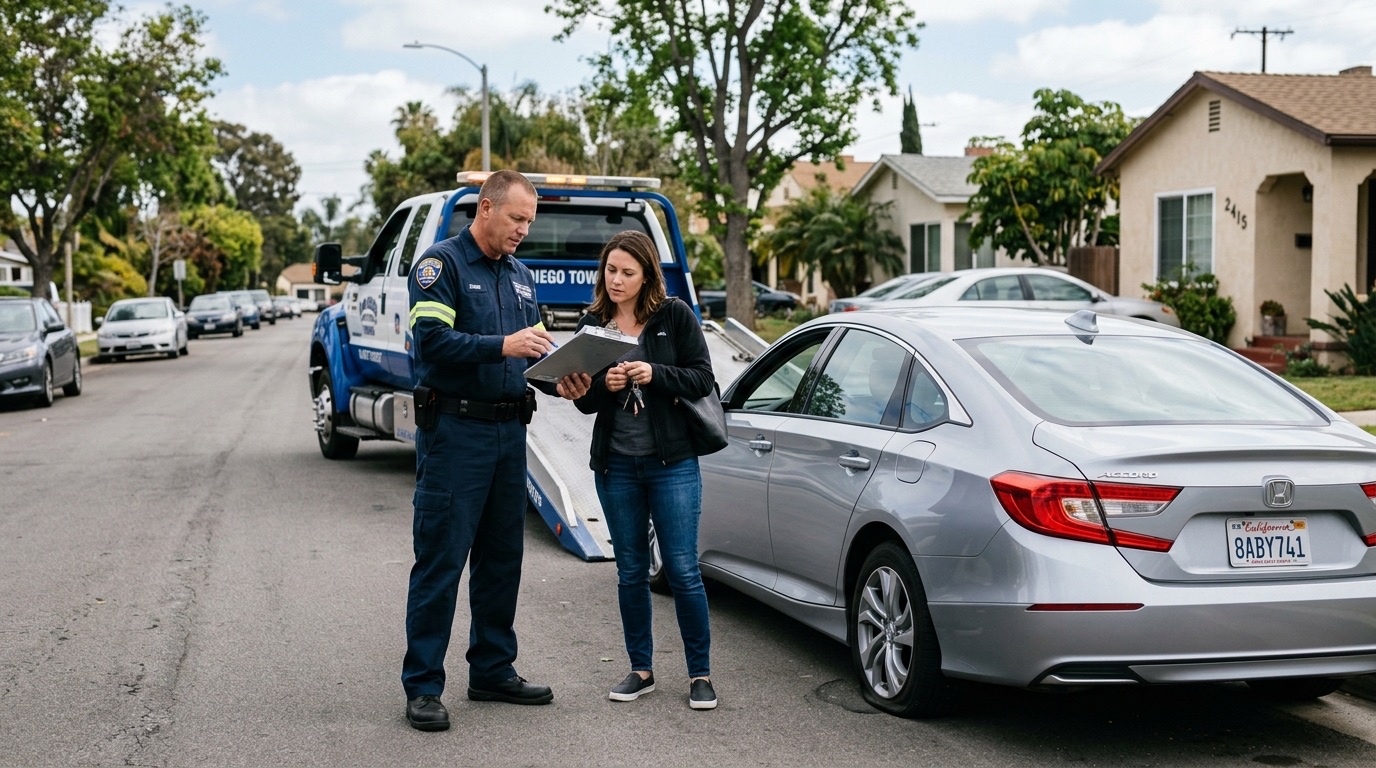
Can a tow truck refuse to take my car in Virginia?
Yes, but only in specific situations under Virginia law. Here's when an operator can refuse, and your rights in the Richmond metro.
What you'll learn
- The legitimate reasons a Virginia tow operator can refuse a job
- When an operator is expected to take the job (police dispatch, insurance dispatch)
- What Virginia's Title 46.2 towing law and the statewide fee ceiling actually say
- Your rights as the vehicle owner if you are refused
- What to do next if no one will take your call
Step by step
- Reason 1 - Vehicle weight or size exceeds the truck's rated capacity (e.g., a standard wheel-lift truck for a loaded box truck or bus that needs a CDL-rated heavy-duty rig).
- Reason 2 - Vehicle is unsafe to tow (hazardous fluid leak, fire risk, structural collapse).
- Reason 3 - Driver cannot verify ownership (no registration, suspected stolen vehicle).
- Reason 4 - Location is unsafe for the operator (active hostile environment, no safe pull-off, an active work zone).
- Reason 5 - Operator does not service that area or that vehicle type (e.g., EV refusal from a non-flatbed-equipped operator).
- When an operator is expected to take it: police-directed scenes, and your own insurance or motor club dispatch on the operator they sent.
If a tow operator refuses your call and you are stranded in an unsafe spot, call 911. VDOT's Safety Service Patrol (SSP) runs on I-95, I-64, and I-295 in the Richmond area, daytime coverage 5 a.m. to 9 p.m. plus an overnight route on I-95 between Hanover and Chester, but it's not a call-out service - it only helps if it's already patrolling nearby. SSP can move your vehicle out of the travel lane and help with a jump, fuel, or a ride to arrange a tow; it doesn't tow the vehicle away itself.
The short answer
Yes, a Virginia tow operator can refuse to take your vehicle - but only in specific situations, not because they don't feel like making the trip, because you're not paying enough, or because they prefer another customer waiting in queue. If an operator refuses your call and the refusal doesn't fit one of the legitimate reasons below, you have recourse.
The legitimate reasons a Virginia tow operator can refuse
- The vehicle exceeds the truck's safe rating. A standard wheel-lift rig cannot safely tow a loaded box truck, bus, or heavy commercial vehicle. Any tow truck rated 26,001 pounds or more requires a driver holding a commercial driver's license (CDL). The operator should dispatch the right equipment or refer you to a heavy-duty operator.
- The vehicle is unsafe to tow. Active fluid leak (gasoline, brake fluid, hydraulic), structural collapse, fire risk, hazardous cargo. Operators are not required to tow vehicles that pose a safety risk to the operator, other drivers, or property.
- Ownership cannot be verified. If you cannot produce a driver's license, registration, or other proof that you have authority to move the vehicle, the operator can refuse. This matters most for vehicles flagged as possibly stolen or vehicles being moved without the owner's consent.
- The location is unsafe for the operator. An active hostile environment, no safe pull-off, an unstable shoulder (the Downtown Expressway's narrow, older roadway is a real example), or a construction zone with no operator access, like the ongoing I-64 widening east of the city. The operator may refuse pending the location being made safe.
- The operator does not service that vehicle type or that area. An operator without flatbed equipment may legitimately refuse an AWD or EV call. They are expected to tell you so you can call another operator.
When an operator is expected to take the job
- Police-directed scenes. Virginia's private-property towing law, Va. Code § 46.2-1231, puts real standing obligations on any operator doing a nonconsensual tow: posted signage at every entrance disclosing the towing policy and the non-emergency phone number of local law enforcement, immediate notification to State Police or local law enforcement when a vehicle is removed, and a full posted fee list plus an itemized invoice on every job. In Richmond specifically, police-directed tows run through the city's single contracted operator, Seibert's Towing, a relationship the city has maintained since 1992.
- Your insurance or motor club dispatching them to you. If your insurer or a motor club has dispatched a specific operator to your location, that operator is contractually bound to the club, not just to you. Refusal triggers contract penalties.
- An existing service agreement with your property. Operators contracted by an HOA, apartment complex, or commercial property must respond to property-management calls on the terms set in that contract.
Virginia rules that matter here
Private property towing (Va. Code § 46.2-1231, § 46.2-1232)
Virginia regulates nonconsensual towing at the state level, then lets each locality set its own fee limits on top. Under § 46.2-1231, a property owner can't have a trespassing vehicle towed without clear signage posted at every entrance disclosing the towing policy and the non-emergency phone number of local law enforcement, and the tow operator must immediately notify State Police or local law enforcement when removing a vehicle. Skipping that notification is a traffic infraction (fine up to $100) and caps the storage charge at one day. Towing businesses must prominently display a full list of fees at their main office and at the recovery site, and cannot collect more than what's posted. As an alternative to towing entirely, a property owner may instead immobilize a vehicle with a non-damaging device, with the removal charge capped at $25.
The statewide fee ceiling (Va. Code § 46.2-1233.1) and Richmond's local cap
Virginia sets one statewide maximum for a nonconsensual tow off private property: a $210 hookup/initial towing fee, plus up to $30 for towing between 7 p.m. and 8 a.m. or on a Saturday, Sunday, or holiday (capped at two such fees per vehicle), and no charge at all for the first 24 hours of storage. Localities can set their own, lower cap by ordinance, and Richmond has: a 2025 city ordinance raised the local hookup fee toward, but still under, the state maximum, with figures reported in local news coverage at roughly $195 for the hookup, a $30 overnight surcharge, a new weekend/holiday surcharge up to $30, storage around $50 per 24-hour period, and an administrative fee around $75 once a vehicle has sat 72+ hours (re-verify these exact figures against Richmond's current code before treating them as final). Henrico and Chesterfield set their own local caps under the same state authority; specific current dollar figures for those two counties weren't independently confirmed and shouldn't be quoted as exact without pulling each county's current code.
Lien and storage rights (Va. Code § 46.2-644.01, § 46.2-1217)
A tow operator holding your vehicle for unpaid towing or storage charges has a legal lien, but has to notify the DMV within 7 business days of taking possession, and once you or your lienholder gets that notice, you have 10 business days to reclaim the vehicle before the operator can enforce the lien. Storage charges on a vehicle with a lien on file are capped at $500. Separately, § 46.2-1217 requires that a tow operator allow the vehicle owner (or another towing business) access for inspection or relocation on written request, and bars an operator from refusing to release a vehicle once you tender payment by cash, insurance check, certified check, money order, or credit card. Refusing a valid payment suspends any further storage charges from accruing.
No single statewide towing license
Virginia doesn't run one dedicated towing-licensure body a consumer can look up. Instead, each locality (Richmond, Henrico, Chesterfield) authorizes towing operators through its own contract or approved-company list under Va. Code § 46.2-1217, overseen by a local towing advisory board required under § 46.2-1233.2. A commercial driver's license (CDL) is required to run a tow truck rated 26,001 pounds or more; lighter trucks run on a standard Virginia driver's license.
Your rights as the vehicle owner
- Right to know who has your vehicle. In Richmond, the city's towed-vehicle lookup tool (apps.richmondgov.com/applications/towviewing) shows make, model, color, partial VIN, and plate for any city-directed tow, retained online for 14 days; call Richmond's non-emergency line, (804) 646-5100, with questions or to report a vehicle stolen. In Henrico, call the police non-emergency line, (804) 501-5000. In Chesterfield, call (804) 748-1251.
- Right to a posted fee list and a written, itemized invoice. Every nonconsensual tow requires the operator to post its full fee schedule and hand over an itemized invoice.
- Right to insist on flatbed for EVs, AWD, lowered, or damaged vehicles. The operator is responsible for using a method that won't damage your vehicle.
- Right to pay by cash, check, money order, or credit card. An operator cannot refuse a valid form of payment and keep charging storage.
- Right to inspect or reclaim the vehicle on written request once you can prove ownership, even before the full balance is settled in some cases.
What to do if an operator wrongfully refuses you
- Document the refusal. Get the operator's name, company, truck plate, time, and stated reason.
- Call another operator right away. Quick Tow Richmond or another reputable operator will dispatch.
- If you're stranded somewhere unsafe, call 911. VDOT's Safety Service Patrol (SSP) is not a call-out service - it patrols I-95, I-64, and I-295 in the Richmond area on a set schedule (daytime 5 a.m. to 9 p.m., plus an overnight route on I-95 between Hanover and Chester). If SSP happens to already be nearby, it can move your vehicle out of the travel lane and help with a jump, fuel, or a ride to arrange a tow, but you can't request it the way you request a private tow, and it doesn't tow vehicles away.
- Report the operator to the relevant locality if the refusal or the pricing looks predatory: Richmond's non-emergency line (804) 646-5100, Henrico's (804) 501-5000, or Chesterfield's (804) 748-1251.
Richmond-metro patterns we see
- Airport and long-distance-traveler refusals. A driver in an out-of-state or rental vehicle near Richmond International Airport in Sandston, or someone hundreds of miles from home broken down on I-95 through the downtown overlap, sometimes gets refused because the operator can't verify rental paperwork or an unfamiliar out-of-state registration on the spot. Pull up the rental agreement or registration on your phone before you call - it usually resolves this fast.
- EV refusals. A wheel-lift-only operator should refuse rather than wheel-lift an EV. That's the correct call, and they're expected to refer you to a flatbed operator. Quick Tow Richmond takes these calls.
- Heavy-duty cascades on I-95 and I-64. A box truck or freight vehicle breaks down near the Bryan Park Interchange or on I-295 and a standard wheel-lift operator arrives, then refuses. Correct - they shouldn't tow what they can't handle - but they should refer you to a heavy-duty operator rather than just leaving.
- Race-weekend and General Assembly-session surges. The Cook Out 400 weekend at Richmond Raceway and General Assembly session periods downtown both concentrate a surge of parking-lot lockouts and dead-battery calls into a short window. Expect a longer wait than normal if you're stuck near either.
- Ice-storm demand spikes. When a hard freeze or ice advisory hits, every operator in the metro gets slammed with dead-battery and slide-out calls at once, especially on Church Hill's and Bon Air's steep, narrow streets. Call early once the forecast turns.
When Quick Tow Richmond has refused calls (and why)
We've refused calls when: (1) The vehicle had an active fuel leak that another operator on scene was already addressing. (2) The location was inside an active police perimeter and we couldn't get clearance. (3) The caller couldn't produce ID or registration and the vehicle looked like a possible recovered-stolen situation. (4) The vehicle was over our gross weight rating - we dispatched a heavy-duty partner instead. Every refusal comes with a clear explanation and, where we can, a referral.
Reporting a problem - useful contacts
- City of Richmond, towed-vehicle lookup and non-emergency line - apps.richmondgov.com/applications/towviewing, (804) 646-5100, confirms whether and where your vehicle was towed within city limits.
- Henrico County Police, non-emergency line - (804) 501-5000, for towing questions and Henrico's Tag N Tow abandoned-vehicle program.
- Chesterfield County Police, non-emergency line - (804) 748-1251 or CCPD@chesterfield.gov, for impound matters handled through the county's approved-tower list.
- VDOT Safety Service Patrol - free, scheduled roadside help on I-95, I-64, and I-295 in the Richmond area; not a call-out service.
- 511 Virginia - 511virginia.org, Virginia's official real-time traffic and incident information service.
Rather have a pro handle it?
Same-day towing and roadside service across the Richmond metro. The line takes calls any hour.
Keep learning.
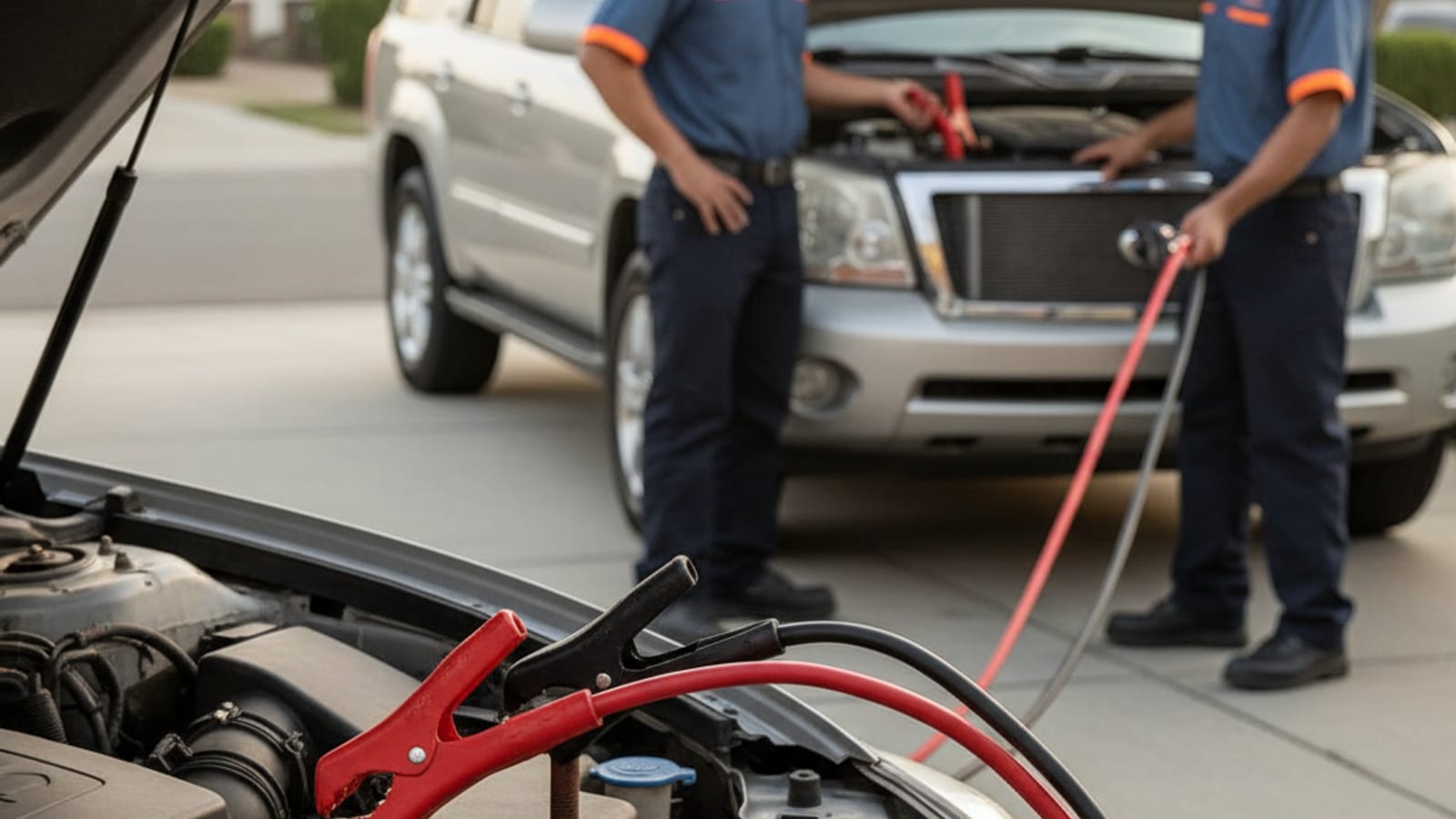
Jump-start a dead battery safely
Jumper cables are simple until you hook them wrong. Do it right and you'll avoid sparks, ruined electronics, and a tow you didn't need.
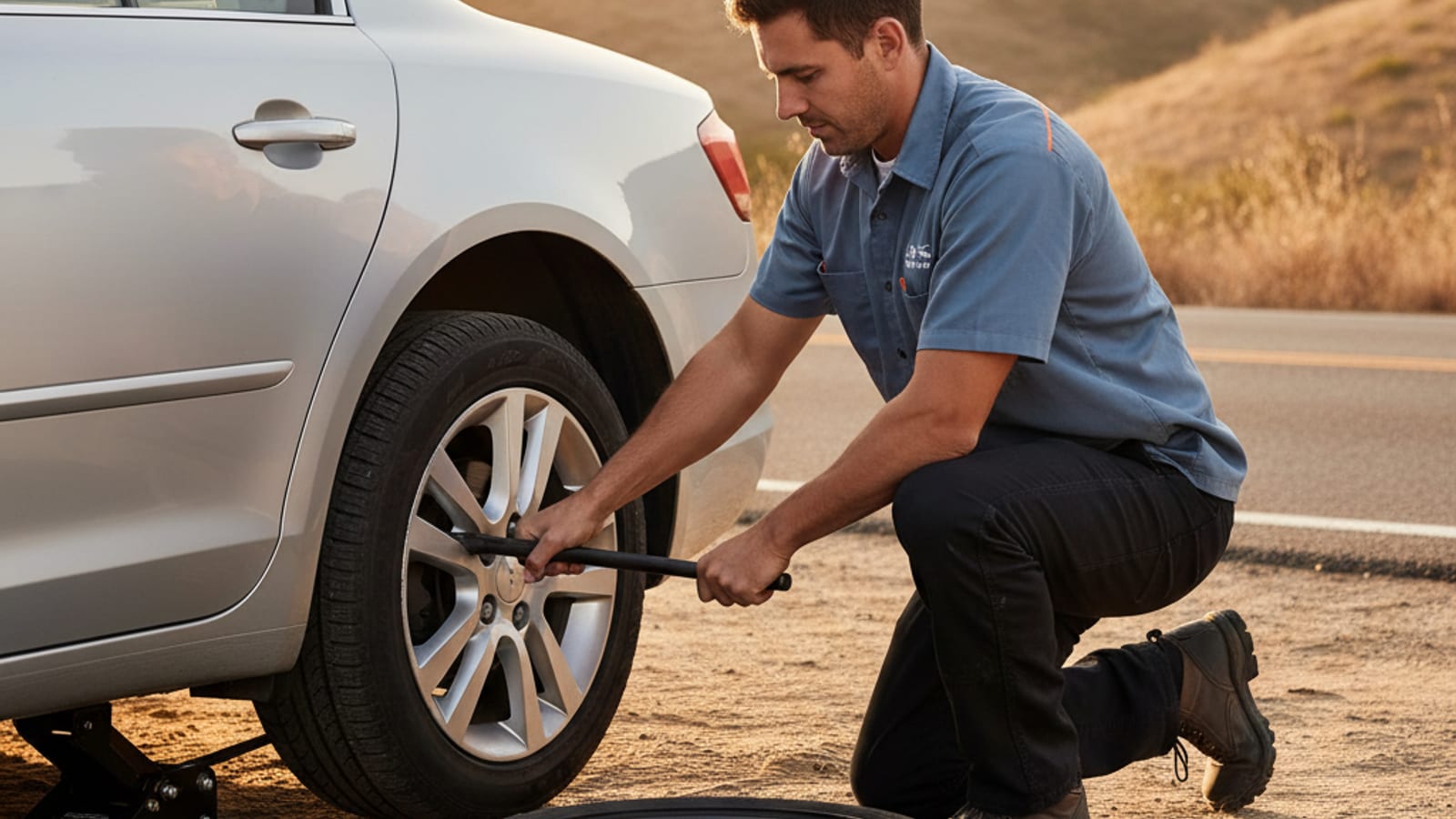
Change a flat tire on the side of the road
The difference between a 20-minute shoulder stop and an hour on the phone with a tow company is knowing where the spare and jack live before you need them.
What to do when your car slides on ice or floods out
Richmond's freeze-thaw winters ice streets fast, and Shockoe Bottom still floods in a summer downpour. First step: stop making it worse.