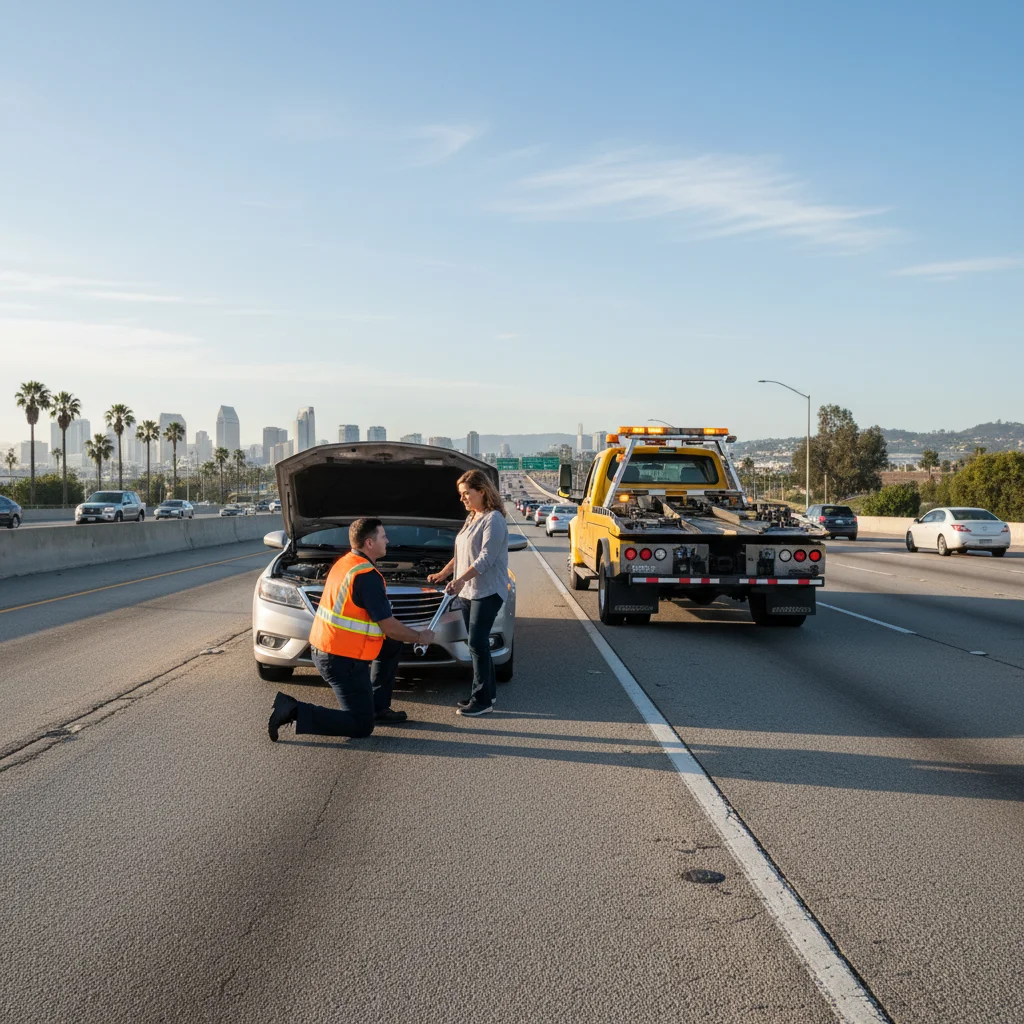
Get as far right as you can, onto the shoulder if there is one, and put your hazards on. Stay belted in if you’re stuck in a live travel lane, or get out on the passenger side, away from traffic, if you’ve made it to the shoulder. Virginia runs a free roadside program called the Safety Service Patrol, or SSP, and it may already be watching this stretch of road. If it isn’t on scene and you need help beyond what a passing patrol can offer, call us directly. Once you’re safely off the travel lane, call (804) 701-6752 and we’ll get a truck moving.
What VDOT’s Safety Service Patrol actually covers
SSP is a VDOT program, co-sponsored by GEICO, that patrols specific interstates statewide, including I-95, I-64, I-81, I-85, and I-66, for free. VDOT’s Richmond District describes SSP as running 24 hours a day, 365 days a year on I-95, I-64, and I-295 in the Richmond area. In practice, full daytime coverage runs 5:00 a.m. to 9:00 p.m., with a narrower overnight route from 9:00 p.m. to 5:00 a.m. covering I-95 specifically between the I-295 interchange in Hanover County (mile marker 84) and Route 10 in Chester (mile marker 61), staffed by one patroller and one supervisor. SSP first arrived in the Richmond region in March 2012 as a pilot program aimed at easing congestion.
On scene, for free, SSP will change a flat using your own spare, deliver fuel, jump a dead battery, top off a radiator with water, get you a ride or a phone to arrange a tow, and give directions, plus manage the incident scene, clear debris, and direct traffic. What it won’t do is perform real mechanical repairs or tow your car away. If your car needs to go somewhere, that’s a private tow. Check 511virginia.org or dial 511 before you drive through the metro for real-time speeds, incidents, and closures on I-95, I-64, and I-295.
Where I-95 actually gets people, through Richmond
I-95 through Richmond isn’t a simple straight shot, and where you break down changes what happens next.
North of the James River, I-95 runs concurrent with I-64 for about three miles through the heart of downtown, from I-64’s eastbound split near exit 75 to its westbound split near exit 79, the stretch locally referenced by the Bryan Park Interchange at the north end. VDOT’s own studies call this the highest-crash, most heavily congested corridor in the region, carrying roughly 149,000 vehicles a day, on top of a Highway Safety Corridor designation running 13 miles from Bells Rd in South Richmond to Parham Rd north of the city, meaning the crash rate there is more than double the state average. A stall in this stretch backs up fast, with almost nowhere for the surrounding surface streets to absorb the overflow. The corridor is about to get busier too: CarMax Park, replacing the old Diamond ballpark, is set to open in 2026 in the same corridor VDOT has already flagged for added traffic pressure.
Just south of downtown, I-95 crosses the James River right next to Richmond’s Main Street Station, the single chokepoint where all north-south I-95 through-traffic funnels across the water. And well south of the city, approaching from the Tri-Cities near Petersburg, the low James and Appomattox River terrain produces a documented, recurring dense-fog pattern distinct from anything closer to the urban core. If you’re driving up from the south, especially early morning or evening, treat that stretch with extra caution.
The long-haul, far-from-home driver
Richmond sits roughly at the midpoint of the I-95 corridor between Florida and the Northeast, which means a real share of the breakdowns we see happen to drivers hundreds or thousands of miles from home, with no local mechanic and no idea what part of Virginia they’re even in. If that’s you, here’s what actually helps: tell us your mile marker or the nearest exit, and we’ll get a truck moving immediately. If your car needs a part that has to be ordered or a repair that won’t happen tonight, we can point you toward a nearby hotel and a shop, so you’re not stuck figuring out a strange city from a gas station parking lot at midnight.
Ice, freeze-thaw, and winter driving
Richmond averages 8.8 inches of snow a season, with January and February the snowiest months, based on the National Weather Service’s 1991-2020 climate normal. The region’s benchmark cold-weather event is the Christmas Eve 1998 ice storm, which coated the area in roughly an inch of ice and knocked out power to 275,000 families. Outside of a major ice event, Virginia’s freeze-thaw cycle, repeated swings above and below freezing rather than one long deep freeze, is what chews potholes into the pavement each winter into early spring, driving tire, wheel, and suspension calls well after the ice itself has melted.
Bryan Park, legislative session, and event traffic
Richmond’s downtown overlap doesn’t just carry commuter volume. The Virginia General Assembly meets at the Capitol, directly adjacent to the corridor, adding a predictable seasonal spike in state-employee commuter traffic on top of hospital-visitor volume headed to VCU Medical Center. Race weekends at Richmond Raceway add their own surge on US-360 and the I-64 approach near Laburnum Ave.
What to do right now if you’re broken down on I-95 in Richmond
Get to the shoulder if you can, hazards on, and stay clear of the travel lane. If you’re inside the downtown overlap or on the James River bridge itself, where shoulder space is limited or nonexistent, try to reach the next exit before you stop if the car will still move. Call us with your mile marker or nearest exit, and if you’re an out-of-town driver who doesn’t know the area, tell us that too. We’ll walk you through the rest.
Frequently asked questions
Can I call VDOT’s Safety Service Patrol directly?
SSP patrols fixed routes and hours rather than working as a dispatched call-out service. On covered stretches of I-95, I-64, and I-295 during patrol hours, a truck may already be scanning for stranded vehicles. If you need help beyond what’s available or you’re outside its coverage, call us or 511 for guidance.
What does SSP do for free, and what won’t it do?
A flat tire change using your own spare, fuel delivery, a jump start, radiator water, a ride or phone to arrange help, and incident scene management. It won’t perform real mechanical repairs or tow your car away.
Why does the downtown I-95/64 overlap back up so badly?
It’s a roughly three-mile stretch carrying about 149,000 vehicles a day, part of a 13-mile Highway Safety Corridor with a crash rate more than double the state average, and it sits directly beneath state-government and VCU Medical Center commuter traffic.
I’m hundreds of miles from home. Can you help me find a hotel and a shop?
Yes. Tell us your situation when you call and we’ll point you toward a nearby hotel and a shop we trust if your repair can’t happen the same night.
Where do I check real-time traffic before I drive through Richmond?
511virginia.org, or dial 511, for real-time speeds, incidents, and closures on I-95, I-64, and I-295.
Does ice season change how fast you can reach me?
Demand rises during a hard freeze or an ice advisory, since dead batteries and slide-outs spike together, but we still get a truck moving as fast as conditions safely allow.
For more on what to do the moment your car won’t start or overheats, see our guide on a car that won’t start or has overheated, or check our roadside assistance, flat tire, and long-distance towing services.